Profile
Larry Page: Organizing information, then investing in possibility
Google’s co-founder helped define the internet search era and later helped build Alphabet for a wider portfolio of bets.
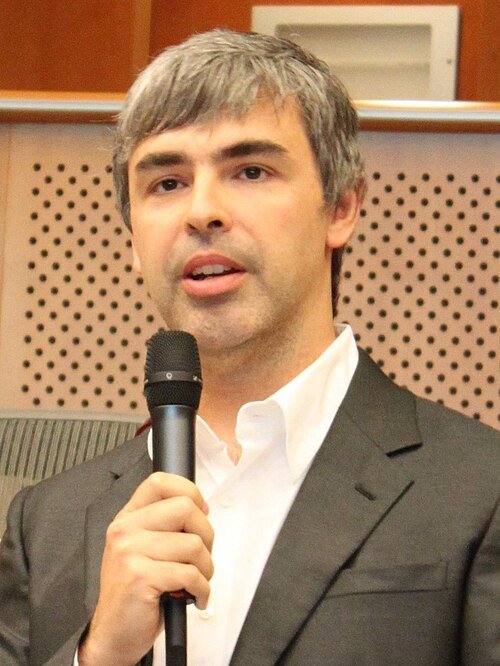
Quick facts
- Born / age
- March 26, 1973, Lansing, Michigan · 53
- Parents
- Carl Victor Page Sr. and Gloria Page
- Education
- University of Michigan; Stanford University (computer science)
- Companies & ventures
- Google, Alphabet and long-term technology investments
Page’s impact comes from pairing technical vision with an organizational model that makes room for ambitious projects.
Early life and education
Lawrence Edward Page was born on March 26, 1973, in Lansing, Michigan. His father, Carl Victor Page Sr., was a computer-science professor and early artificial-intelligence researcher; his mother, Gloria Page, taught computer programming. The family home contained early personal computers and science magazines, giving Page unusual exposure to technology while still a child.
Page studied computer engineering at the University of Michigan and then went to Stanford for graduate study in computer science. There he met Sergey Brin. Their research into the structure of links on the web became the basis for an improved search engine, first called Backrub and later Google.
Companies, holdings and ventures
Page co-founded Google with Brin in 1998. He was Google’s CEO in its early years, returned to that role in 2011 and then became CEO of Alphabet when the holding-company structure was created in 2015. In 2019, he stepped down as Alphabet CEO while remaining a co-founder, shareholder and member of Alphabet’s board.
Page’s commercial influence is anchored in Google and Alphabet rather than a large public list of separate companies. Alphabet was designed to let the core Google business operate alongside longer-term technology bets. His current public role is more board-level and strategic than daily operational management.
A better way to search
Larry Page co-founded Google with Sergey Brin in 1998 while they were Stanford students. Their early work helped establish a new standard for finding useful information on the web, turning a research problem into one of the most widely used technology products in the world.
The original insight was technical, but its commercial effect was broader. Search became a gateway to the internet, creating a platform that could support advertising, maps, email, mobile software and many other services.
The Alphabet structure
In 2015, Alphabet became Google’s parent company, giving the organization a way to separate the core internet business from a portfolio of longer-term ventures. Page served as Alphabet’s CEO before moving out of that role in 2019; he remains a co-founder, shareholder and member of the company’s board.
This structure reflects an important leadership idea: mature businesses and experimental projects can benefit from different time horizons, metrics and operating models.
The big-bet mindset
Page has long argued for ambitious goals and the value of working on problems that may initially look improbable. The practical lesson is not to pursue novelty indiscriminately. It is to create enough organizational room for serious exploration while protecting the rigor that keeps a company useful.