Profile
Tim Cook: The operating system behind Apple’s scale
Apple’s CEO has paired product ambition with a disciplined approach to supply chains, services and global operations.
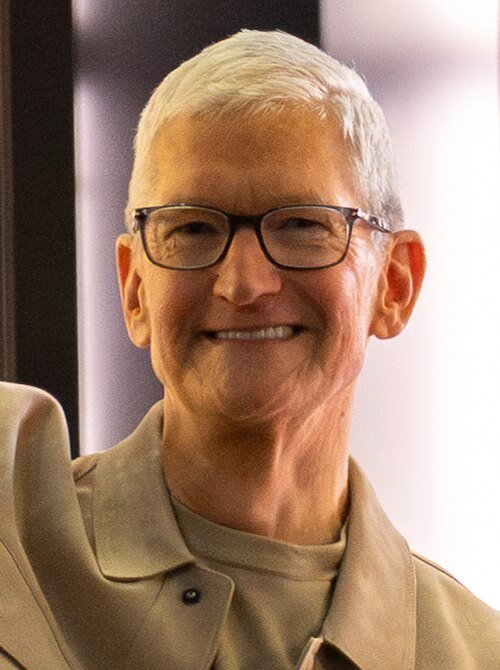
Quick facts
- Born / age
- November 1, 1960, Mobile, Alabama · 65
- Parents
- Donald “Don” Cook and Geraldine Cook
- Education
- Auburn University; Duke University (MBA)
- Companies & ventures
- Apple; prior leadership at IBM, Intelligent Electronics and Compaq
Cook’s leadership demonstrates how operational excellence can create room for creativity at immense scale.
Early life and education
Timothy Donald Cook was born on November 1, 1960, in Mobile, Alabama, and grew up in nearby Robertsdale. He was one of three sons of Donald “Don” Cook, who worked in a shipyard, and Geraldine Cook, who worked in a pharmacy. Cook has credited his parents’ sacrifices and work ethic as foundational to his career.
He graduated from Robertsdale High School and earned an industrial-engineering degree from Auburn University in 1982. He later completed an MBA at Duke University, where he was a Fuqua Scholar. His academic path reflects the systems thinking that has characterized his career: understanding how people, materials and processes fit together at scale.
Companies, holdings and ventures
Cook is a professional operator and executive, not a founder of a personal group of companies. Before Apple, he spent 12 years at IBM, held an operating role at Intelligent Electronics and became vice president of Corporate Materials at Compaq. He joined Apple in 1998 and became chief operating officer before succeeding Steve Jobs as CEO in 2011.
His business footprint is Apple’s global ecosystem of hardware, software, services, retail and supply-chain partnerships. He serves on Apple’s board and remains responsible for the company’s overall strategy. Apple has announced that Cook will become Executive Chair on September 1, 2026, with John Ternus succeeding him as CEO.
Operations as a strategic asset
Tim Cook joined Apple in 1998 and became CEO in August 2011 after serving as chief operating officer. His earlier responsibilities covered worldwide sales and operations, including the supply chain, service and support. That experience shaped a leadership style centered on execution at scale.
For a company making integrated hardware, software and services, operations are not merely a back-office function. They influence product availability, quality, margins and the customer experience itself.
Building beyond one product cycle
Under Cook, Apple has continued to develop its device ecosystem while growing services and deepening its global relationships. The challenge in this type of business is balancing speed with control: new products must arrive with a high level of reliability, while supply and support must work across many markets.
The visible result may be a product launch. The less visible work is a global network of design, engineering, manufacturing, retail and service decisions that makes the launch possible.
A leadership lesson in repeatability
Cook’s career is a reminder that great companies need operating systems as much as they need big ideas. A repeatable method for making decisions and delivering products can be one of the most valuable forms of innovation.